Inclusive Remote Meetings
Automated analysis of turn taking behaviour in video meetings (meeting analytics).
2021
Duration: 3 months
Role: Human-Computer-Interaction Researcher (Microsoft Research)
Team: Future of Work, D&I
Methods: Quantitative Research, Data Visualization, PowerBI, RStudio, Plotly
Impact: Supported research on AI to improve Teams Videoconferencing and support remote meeting inclusion. Developed a GDPR-compliant automated method to extract, visualize and analyse meeting metrics and assess meeting inclusion. Investigated overlapping talk in video meetings and proved that there is possibility to develop meeting behavioural profiles from de-identified meeting metrics.
Overview
During my internship with the Future of Work Cluster at Microsoft Research, I investigated how AI could be used to improve inclusivity and participation in remote meetings.
Challenge
Video meetings are notorious for difficulties with conversational turn-taking, which has impacts on meeting inclusion, effectiveness and collaboration outcomes. To support more inclusive remote meeting, it would be meaningful to detect non-inclusive behaviours - e.g. someone systematically interrupting the meeting - and design relevant features to support turn taking - e.g. personalized notifications for meeting’s attendes, overall meeting inclusion metrics etc.
To address this, I developed scalable GDPR-compliant process to automatically extract remote meeting metrics and detect competitive and collaborative overlapping talk in these meetings.
Design & Research Approach
Working with data from 34 remote meetings across 10 meeting series involving 52 Microsoft Research employees, I used this process to identify and classify patterns of overlapping speech, distinguishing between collaborative overlap (supportive interruptions) and competitive overlap (negative interruptive behaviours). I then analysed and visualised (RStudio, PowerBI, Plotly) these interaction patterns to better understand participant behaviour and meeting dynamics.
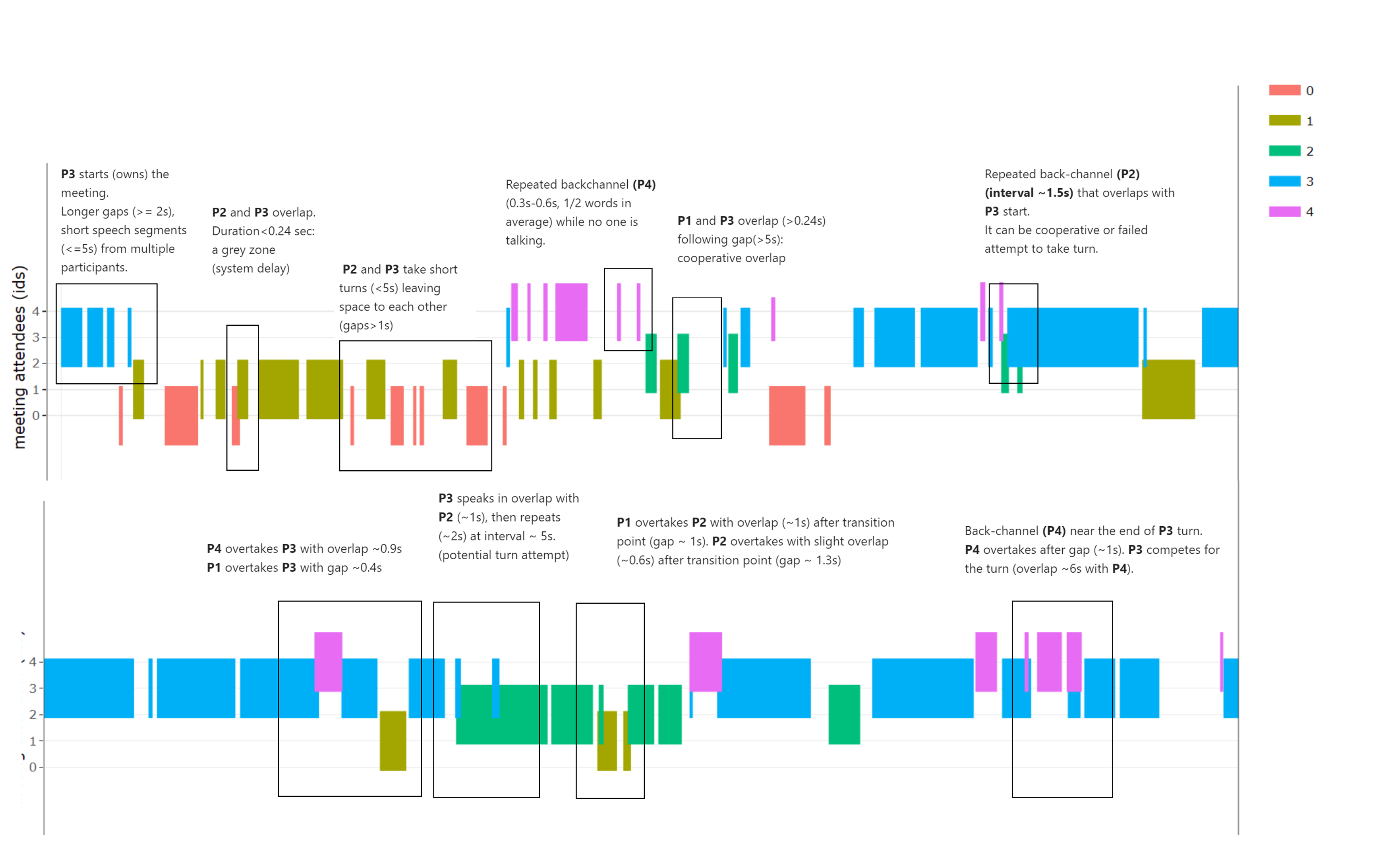 Above: Visual identification of patterns in a multiparty meeting (eyes-off transcripts).
Outcomes
The project demonstrated that turn-taking behaviours could be characterised at scale, enabling the creation of behavioural profiles that identified participants who were more likely to hold, cede, or interrupt conversational turns. These insights provided a foundation for developing AI-powered meeting features aimed at improving inclusivity, such as participation analytics, meeting health indicators, and personalised nudges to support balanced discussion.
Key outcomes included:
- Designing a privacy-preserving, GDPR-compliant process for analysing meeting behaviours from transcript data.
- Developing scalable approaches for identifying conversational patterns associated with meeting inclusion and participation.
- Generating actionable insights for AI-driven workplace tools that support more effective and inclusive collaboration.
- Contributing research that informed Microsoft’s strategic thinking around AI-assisted collaboration and the future of work.
Impact
My research informed industry report on the future of work and use of AI to improve meeting outcomes, see Microsoft Research - New Future of Work report 2022, page 50.
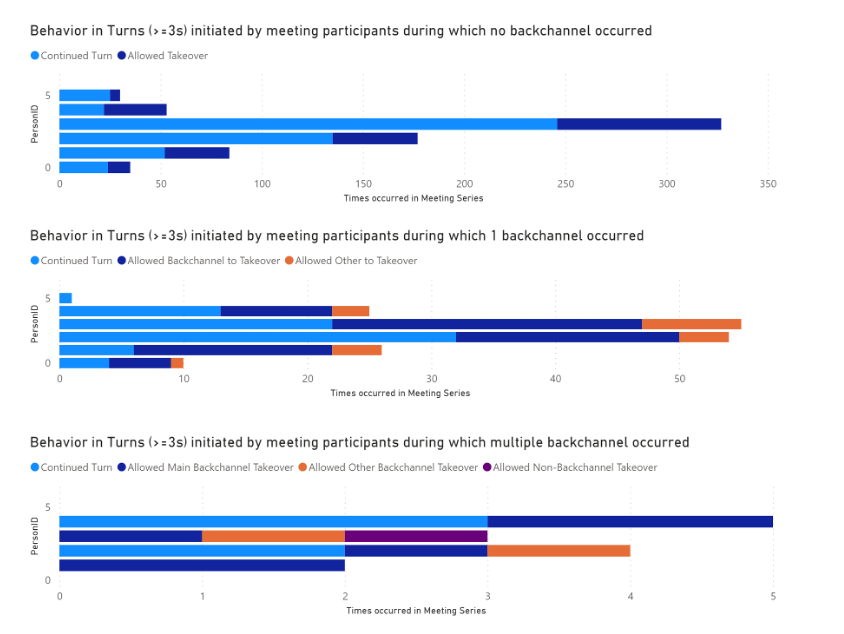
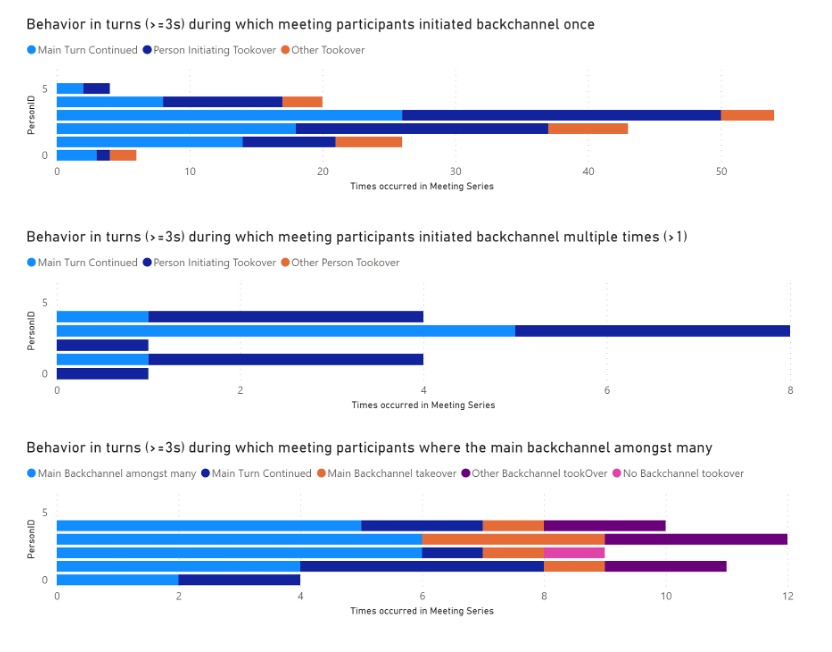 Above: Automatic Pattern Identification: Behaviours when initiating turns and when initiating overlap during a turn. This type of automated visual analysis can be meaningful to compare different behaviours of meeting participants within a meeting series, and the basis of developing profiles of turn-taking behaviours.
This work also resulted in a peer-reviewed publication, which presents the scalable automatic process to categorize turn-taking patterns in remote meetings based on eyes-off analysis of meeting transcripts - see the publication here.
Key paper takeaways:
- My analysis shows initial success characterizing people’s behaviours as either likely to continue or cede turns based on either the amount of overlap that they produce during other’s turns or the amount of overlap they experience in their own turns.
- My research shows a promising GDPR-compliant approach of categorising overlapping talk and turn-taking behaviour in meetings and developing meeting behavioural profiles to assess meeting inclusion and outcomes.