GenAI Collaborative Workflows
Product research & collaboration through Interactive AI-generated Storyboards
2024-2025
Duration: 6 months
Role: Senior UX Researcher, TORUS Digital Health Project
Team: Design Team, Clinical Experts, ML engineers
Methods: Fabrication, hardware, software, Physical Prototyping, User Experience Evaluation, Design Criteria, Co-creation
Impact: Designed an AI-powered interactive storyboard tool that enabled designers, researchers, clinicians, engineers and patients to collaboratively discuss future digital health experiences. The approach informed product decisions across the TORUS programme and demonstrated how Generative AI can scale concept exploration and product research.
Overview
As part of the EPSRC-funded TORUS programme, I designed and deployed an interactive storyboard tool (MidJourney Gen AI, Figma) that supported product design, stakeholder collaboration, and user research for a smart home monitoring system for Parkinson’s disease.
TORUS combines computer vision, wearable sensing, and voice technologies to support at-home health monitoring. The complexity of the system created challenges when discussing future user experiences with engineers, clinicians, patients, and carers.
To address this, I developed an interactive storytelling approach that allowed stakeholders to explore, evaluate, and shape potential product experiences before implementation.
The purpose of the storyboard tool and the associated studies was to support internal collaboration - engaging with engineers within the project to discuss and coordinate product development - as well as external user research - investigating the acceptability and appropriateness of different interaction scenarios with participants, and unpacking ethical concerns around privacy, use and development of AI algorithms and data collection, processing and use.
The Challenge
The TORUS system involved numerous interaction possibilities across different devices, contexts, and user needs. Traditional storyboards were insufficient for communicating this complexity, comparing alternatives, or gathering structured feedback on future concepts.
The challenge was to create a research and communication tool that could:
- Visualise future interactions with the system.
- Support exploration of multiple design alternatives.
- Enable stakeholders to actively participate in design decisions.
- Scale efficiently as the product evolved.
My Role
I led the design and development of the interactive storyboard tool, combining Generative AI, interaction design, user flows, and research methods.
My responsibilities included:
- Designing branching user journeys and interaction scenarios (Figma).
- Creating AI-generated visual assets using Midjourney.
- Developing interactive prototypes and research studies in Figma.
- Facilitating stakeholder workshops and user research sessions.
- Synthesising findings into design recommendations for the TORUS team.
Design Approach
The storyboard followed a branching narrative structure inspired by decision trees and conversational user flows.
Rather than presenting a single future scenario, participants could navigate alternative interaction paths and evaluate different ways of interacting with the system, including:
- Voice-based interactions.
- Wearable notifications and reminders.
- Mobile and tablet interfaces.
- Consent and privacy management.
- Data validation and journaling experiences.
Using Midjourney, I generated visual scenes representing daily life with Parkinson’s and rapidly created alternative interaction concepts. These visuals were organised into interactive Figma prototypes, allowing participants to make decisions, explore different paths, and provide feedback directly within the experience.
This approach transformed the storyboard from a passive communication artefact into an interactive research tool.
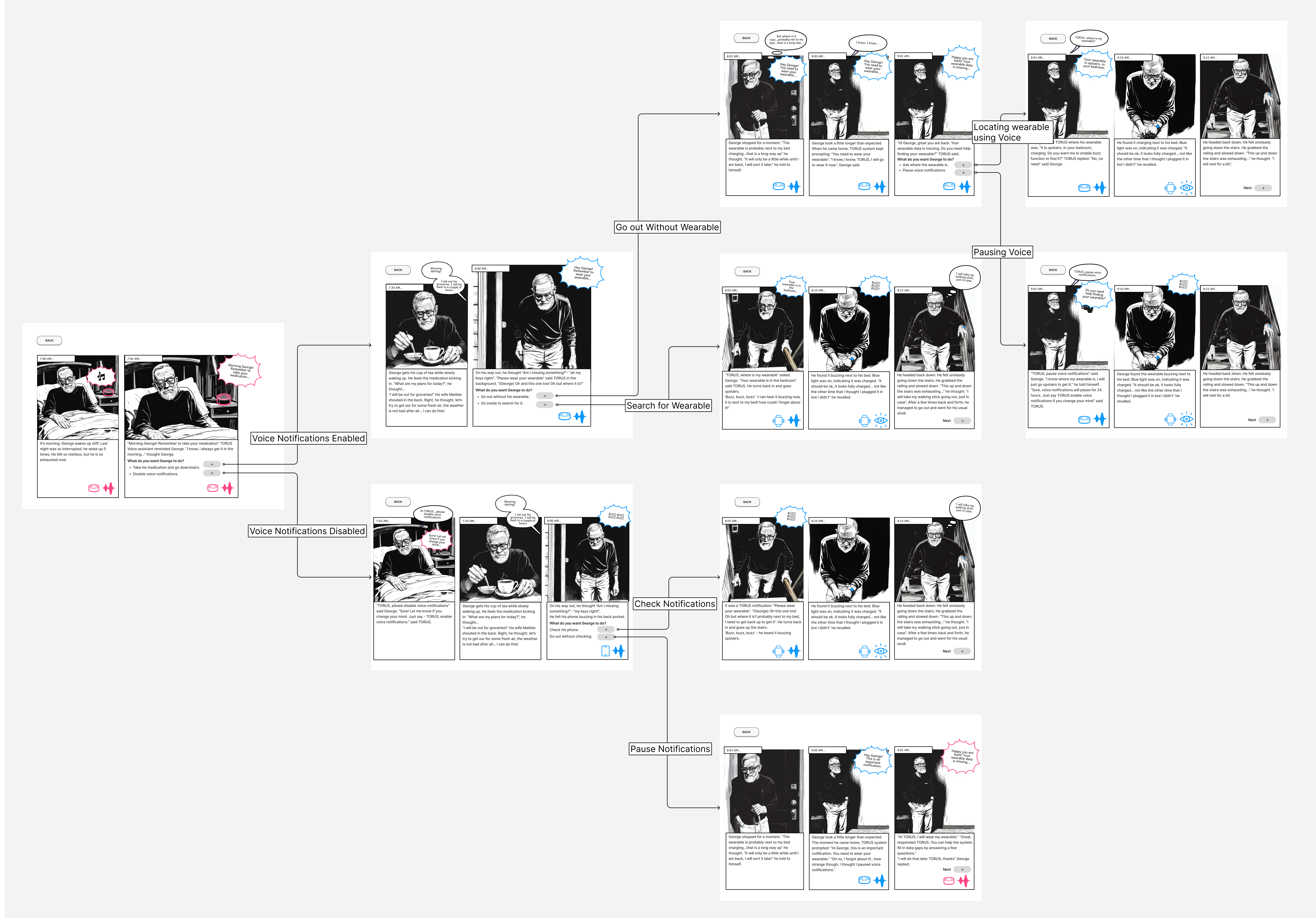
Above: A diagram showing example of the branching in the storyboard. The first versions of the storyboard used one character and exesive branching to investigate potential interactions. Later, more characters were developed, while the amount of branching was reduced (due to decisions taking place).
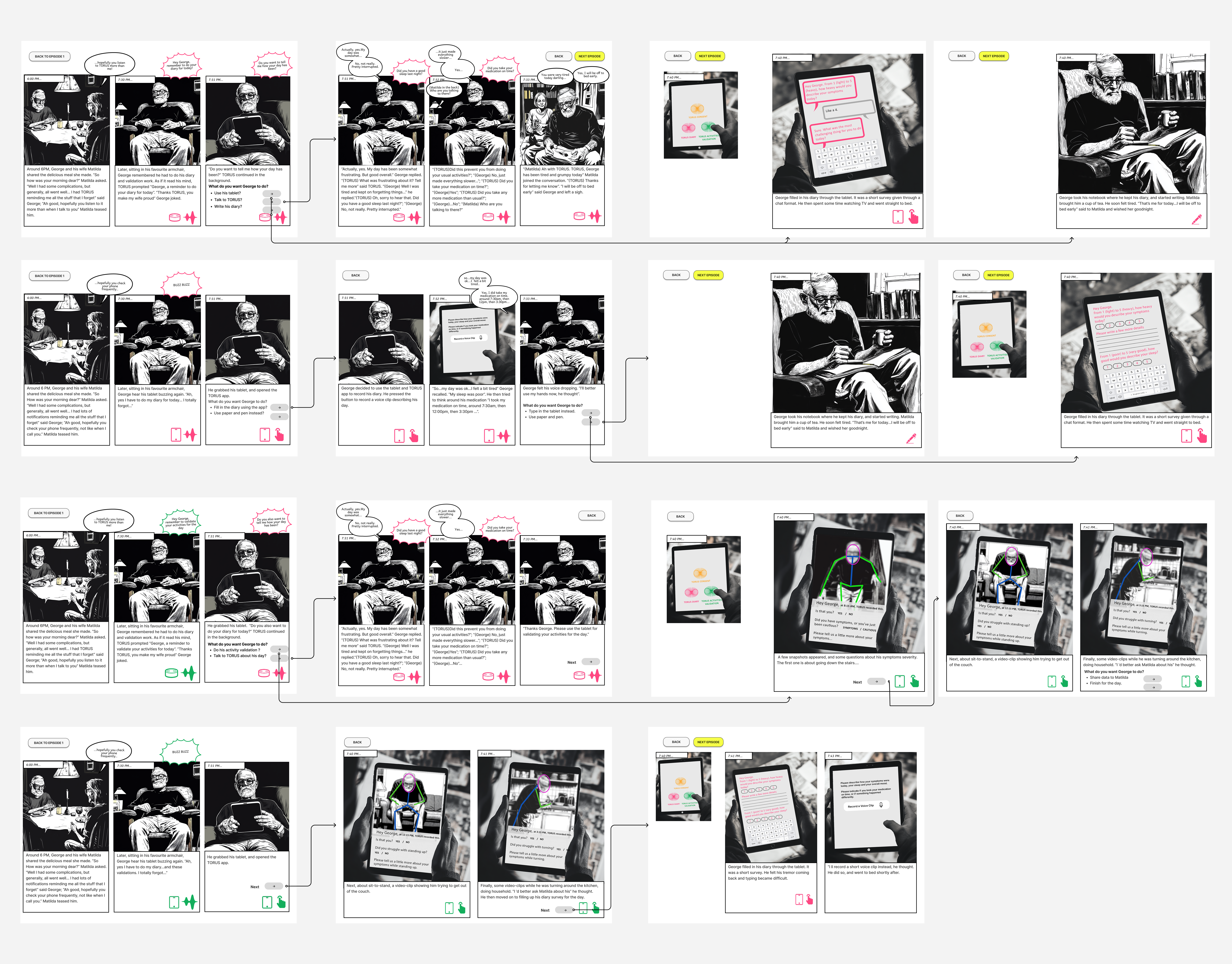
Above: A diagram showing example of the branching in the storyboard.
Above: Example of interactive branching in the storyboard.
The final Storyboard
Through iterative engagements with internal and external stakeholders, the storyboard supported handling complexity of the decisions around the system’s design, consolidating feedback from engineers and patients/carers. The use of Gen-AI tool Midjourney made it possible to constantly update the storyboard effortlessly, from producing interaction alternatives worth exploring, to integrating new concepts and keeping everyone in the project up-to-date with the design requirements and the design progress of the TORUS system.
Above: Short video-clip showcasing part of one version of the storyboard
Above: A version of the interactive storyboard (Figma) used as a tool to conduct online studies, investigating interaction scenarios with the home monitoring system. The storyboard was essentially an online survey, whereby one can nagivate different interaction scenarios using buttons and leave feedback on an embedded survey.
Outcome
Over six months, the storyboard became a central design artefact within the TORUS programme, supporting collaboration between 20+ researchers, engineers, clinicians, patients, and carers.
The platform was used in qualitative interviews with 10 participants and later deployed as an online study involving an additional 20 participants. Findings informed product requirements, interaction design decisions, and recommendations for future versions of the TORUS system.
The project also demonstrated how Generative AI can significantly accelerate storyboard creation and concept exploration, enabling teams to rapidly visualise and evaluate large numbers of future product experiences that would traditionally require substantial design effort.
Impact
Created a scalable approach for combining Generative AI, interactive prototyping, and user research to evaluate future product concepts. The storyboard platform informed key design decisions across the TORUS programme while enabling stakeholders to actively shape interaction designs, privacy features, and user experiences before development.