My PhD research focused on understanding existing pitfalls with smart buildings from a human angle, to inform the design of smart environments that bring value to their residents. Following a human-centered design approach and focusing on a specific smart office building, I led a series of qualitative and design-led studies with building occupants - including focus groups and co-design workshops - to understand existing complexities, views and perceptions on data collection, processing and use in the building, frame the design space for possible improvements, and propose specific interventions to support data awareness and wellbeing.
Complementary to this, I followed by mixed methods research approaches, conducting diary studies, surveys, and wearable deployments to investigate longitudinal relationships between humans and building data, perceived environmental conditions - i.e. noise, air quality - and dimensions of resident’s wellbeing - i.e. fatigue.
Overall, my research highlighted:
- The need for designing technologies to support spatialized GDPR for building interiors - e.g. supporting data awareness and providing levels of user control on data collection.
- The opportunities for AI and physical computing to empower building users utilizing data for their own benefit, developing prototypes to demonstrate this, incl. an interactive office divider that surfaces air quality data.
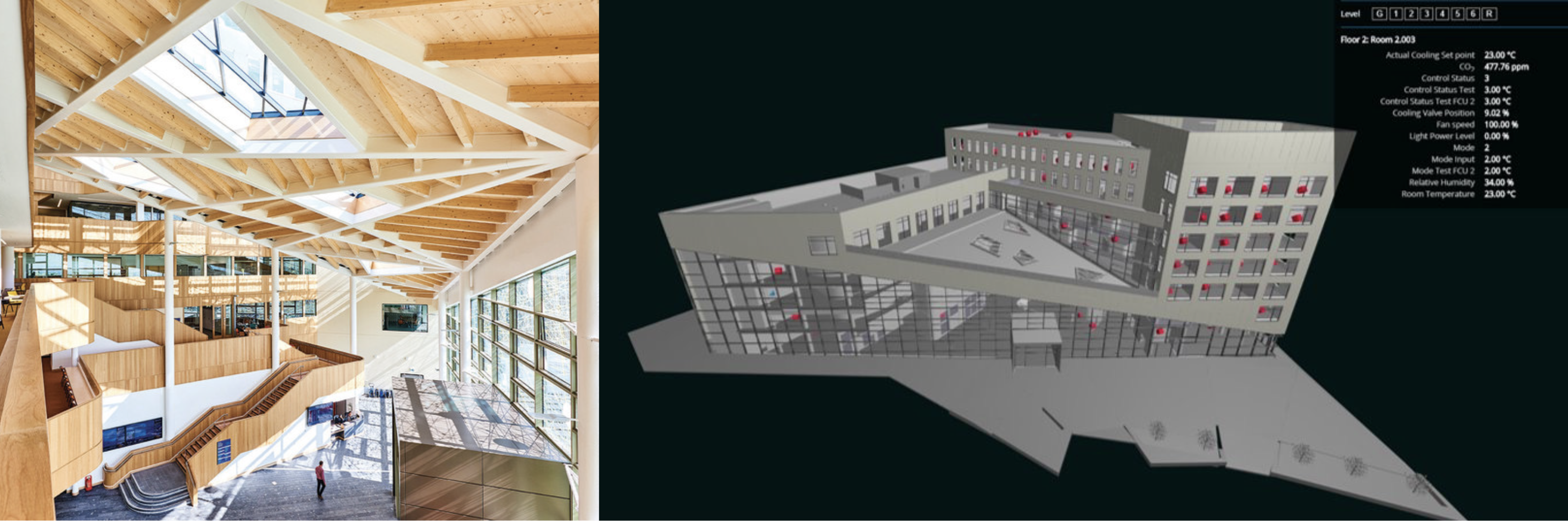 Above: Image of the building’s autrium and the building’s open data stream (API).
Three publications have been produced from this series of studies.
The first focuses on unpacking how the building occupants perceive data collection and use within the smart building - particularly how data is used to improve wellbeing - and speculating on design solutions in that utilize data differently. The paper frames a design agenda for improving smart building’s occupant experiences and increasing the perceivability, accessibility, usability and ethical use of data and AI in such buildings - published in the ACM CHI 2023 conference proceedings, see publication.
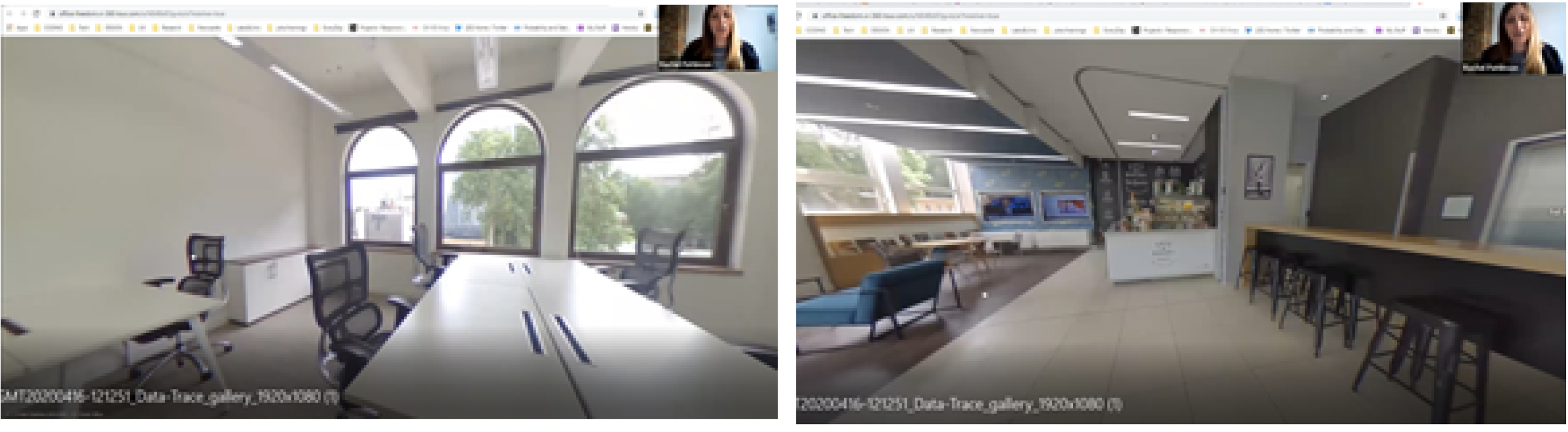 Above: Co-Design Workshop (online) - Participant speculating about alternative uses of data in smart buildings through 360 images. The participant envisioned an app whereby all building sensory data are processed to provide recomendations on where to work based on personal preferences / task needed to accomplish - e.g. the most quiet place in the office etc.
The second one focuses on unpacking correlations between wellbeing (self-reported data), perceived environment (e.g. noise, light, temperature) and sensory data (obtained by wearable devices) over a period of remote working (due to COVID-19) - published at Frontiers of Computer Science, see publication.
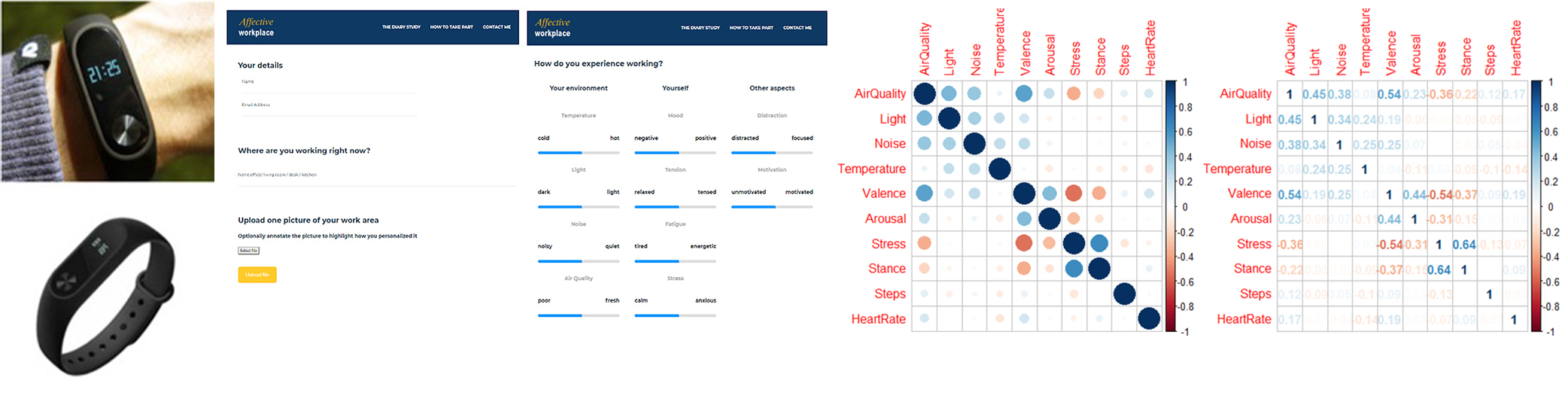 Above Left: Wearable and custom web app used for data qualitative and quantitative collection. Above Right: Correlations Plot between key self-reported wellbeing and environmental data.
The third one discusses findings from a co-design workshop using a custom card-kit, focusing on designing physical interactions for supporting health and wellbeing in the built environment in the context of the hybrid workplace - published in MDPI Architecture, Healthy Habitats—Innovative Approaches to Creating Built Environments That Support Health and Wellbeing see publication.